
Most Enterprises Are Running Modern Strategy on Outdated Execution Capability
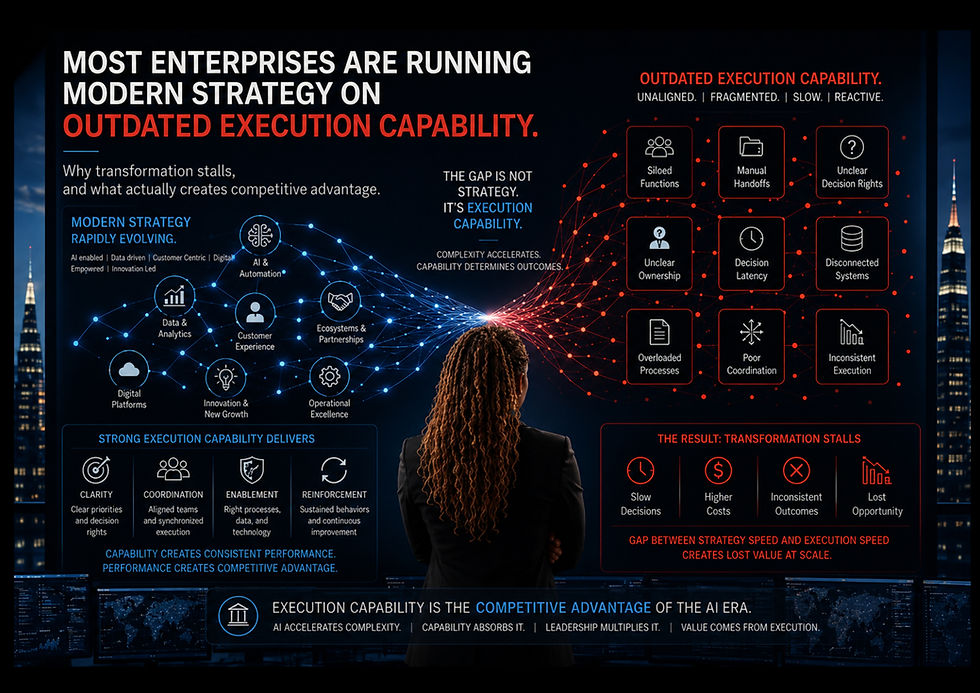
After nearly 30 years of working inside large-scale transformation, I have heard some version of the same question repeatedly from enterprise leaders: “We have the right strategy and the right people, so why is this still stalling?”
Most organizations assume the answer is execution discipline, communication, or resistance to change. But it is not. The primary constraint on modern enterprise transformation is a structural mismatch that most organizations have never formally diagnosed. They still treat execution as a management activity rather than an organizational capability that must be intentionally designed, reinforced, and sustained.
Picture a leadership team eighteen months into a major transformation. The strategy is well-reasoned, the executive sponsor is engaged, and the technology investment is funded. Experienced leaders are in place across every relevant function.
And yet, the initiative is slowing.
Sales, operations, finance, and technology are each making decisions through different accountability models. Every function believes it owns prioritization. Nobody owns enterprise synchronization. Escalations that should take days take weeks. Alignment achieved in one meeting dissolves before the next.
The transformation does not fail spectacularly. It just gradually loses coherence.
This scenario is not unusual. It is the dominant pattern of transformation underperformance, and the explanation most organizations reach for first rarely identifies the actual cause.
The actual cause is architectural.
What Most Diagnostics Miss
Organizations have spent decades investing in strategy development, process optimization, change management, and digital modernization. The methodologies are mature, and the frameworks are everywhere. Yet transformation initiatives continue to underperform at consistent rates, which suggests the problem is not a shortage of frameworks.
The problem is that most frameworks assume the organizational systems required for coordinated execution already exist. Very few disciplines focus directly on how governance, accountability, decision-making, and cross-functional coordination actually operate under enterprise complexity.
A project plan tracks milestones. A transformation office coordinates initiatives. An OKR system aligns objectives. A change management methodology supports adoption. Each of these adds value, but none of them, individually or collectively, answers the deeper structural questions:
How do decisions actually move across this organization?
Who owns outcomes when accountability crosses functions?
How does governance hold when operational pressure rises?
Can this enterprise sustain transformation after executive attention shifts?
Those questions expose something different. Not process maturity. Not leadership quality. They expose the structural architecture of execution itself.
Organizations often scale complexity faster than they scale the decision architecture required to manage it. The consequence is predictable: an enterprise running modern digital systems, sophisticated data infrastructure, and AI-enabled workflows on top of governance structures designed for slower, more linear businesses will generate increasing internal friction over time.
This happens not because people are performing poorly, but because the operating structure is mismatched to the level of complexity it is being asked to carry.
Most organizations do not actually know how decisions get made across the enterprise. They know how the org chart says decisions should get made.
The Execution Architecture Smoke Test
Before diagnosing a culture or capability problem, ask your leadership team three questions:
Does an escalation between two departments take longer than 48 hours to resolve?
If your top transformation leader left tomorrow, would the initiative's momentum drop by more than 50%?
Do cross-functional meetings consistently end in "alignment" that vanishes by the following Monday?
If you answered yes to any of these, your organization does not have a people problem. It has an architectural deficit.
The Five Structural Conditions That Cause Strategy to Stall

These conditions do not simply weaken execution performance. Over time, they erode enterprise execution capability itself.
01. Governance Drift
Governance begins clearly during planning phases, then weakens as initiatives move into operational execution. Decision forums become inconsistent, escalations bypass structure, and competing authority centers emerge. What looks like slowing momentum is often a governance architecture that was never designed to sustain itself under pressure.
02. Accountability Diffusion
Organizations assign responsibility without establishing enforceable ownership structures. Everyone participates; nobody truly owns outcomes. In matrix environments, this ambiguity is structural, not behavioral. Accountability diffusion is not a people problem; it is an architecture problem disguised as one.
03. Coordination Fracture
Most large initiatives fail at the seams between departments. Each function optimizes internally while the enterprise loses synchronization overall. Execution architecture must govern interdependence, not just functional performance. Treating coordination fracture as a communication issue is like treating a structural crack in a building as a paint problem.
04. Decision Velocity Breakdown
As complexity increases, decision-making slows because authority boundaries are unclear or politically constrained. Organizations mistake consensus for alignment. Execution speed deteriorates long before leaders formally recognize it, and by the time it surfaces as a visible problem, months of momentum have already been lost.
05. Reinforcement Failure
Many organizations launch transformation effectively but fail to institutionalize new operating behaviors. Without structural reinforcement mechanisms, the organization reverts to legacy patterns once executive attention shifts. This is not a change management failure; it is a design failure. The new behaviors were never embedded into the operating architecture.
Why AI Will Accelerate This Problem, Not Solve It

There is a growing assumption across enterprise leadership that AI will reduce organizational complexity by accelerating decisions, automating workflows, and improving information flow.
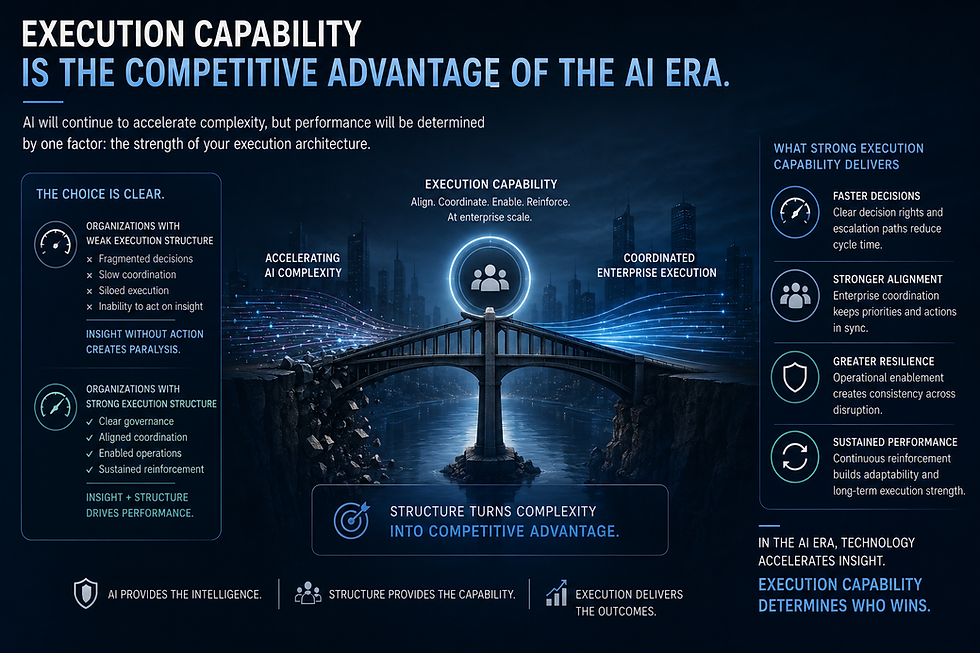
AI can accelerate information movement. It does not automatically strengthen the governance, coordination, and accountability systems required to act on that information coherently across the enterprise.
In many organizations, information can now travel at machine speed while authority still moves at committee speed.
As enterprises embed AI across operations, supply chains, customer ecosystems, and decision environments, execution complexity increases alongside technological capability. Insights surface faster, dependencies multiply, and operational decisions increasingly require coordination across interconnected functions operating at different speeds and priorities.
Yet many organizations still rely on governance pathways, approval structures, and escalation mechanisms designed for slower, more linear operating environments.
This creates a widening structural gap between insight generation and enterprise execution capability.
Consider an organization deploying AI-enabled demand sensing across its supply chain. Insights that previously took weeks to identify now surface in hours. Yet the governance structures required to act on those insights, including decision ownership, prioritization authority, operational coordination, and conflict resolution, may still depend on fragmented committees, siloed approvals, and delayed escalation processes.
The intelligence accelerates. The organizational coordination systems often do not.
In many enterprises, insights surface in hours while operational alignment still depends on fragmented approvals, competing priorities, and governance cycles designed for slower environments.
This is why execution capability is becoming a strategic differentiator in AI-enabled enterprises. Technology can accelerate insight, but sustained enterprise performance still depends on the structural systems capable of aligning governance, accountability, coordination, and execution across increasing complexity.
Organizations that extract the greatest value from AI will not necessarily be those with the most advanced models. They will be the organizations with execution systems capable of absorbing complexity, coordinating decisions rapidly, and sustaining aligned action across the enterprise.
The 4 Structural Systems of Enterprise Execution Capability

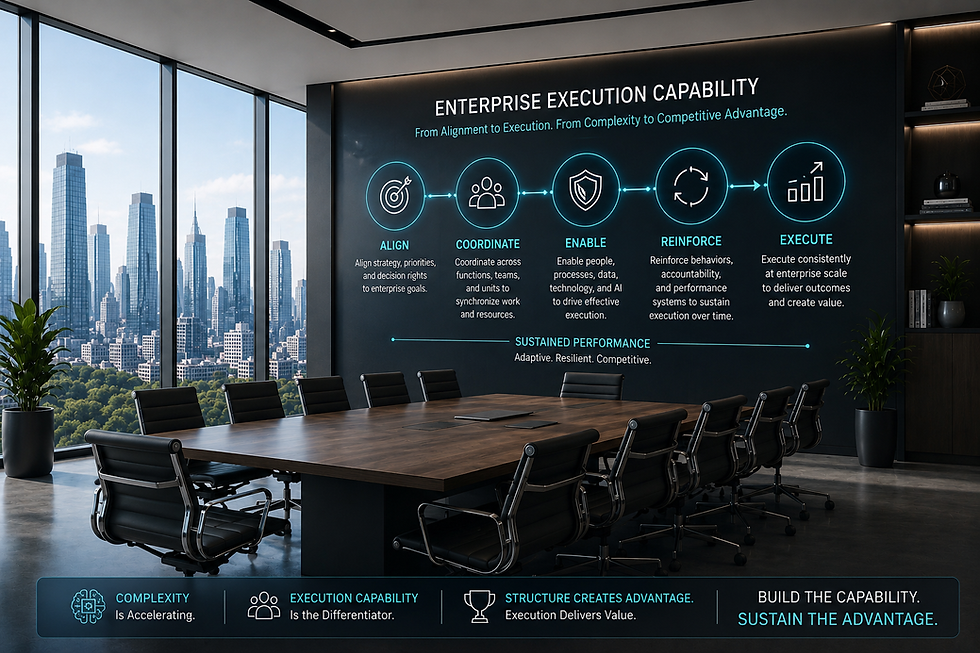
To transition from organizations that rely on heroic leadership to organizations that execute by design, executives must intentionally strengthen the structural systems that allow enterprise execution capability to sustain across complexity, transformation, and operational change.
These systems establish the governance, coordination, accountability, and reinforcement conditions required for execution to remain aligned under pressure, not just during periods of stability.
1. Governance Alignment
Enterprise execution capability begins with clear governance structures that define how decisions are made, how priorities are aligned, and where accountability ultimately resides across the enterprise.
Many organizations unintentionally diffuse accountability through overlapping authority structures, excessive approvals, and fragmented cross-functional ownership. Traditional RACI models can sometimes reinforce this problem when “Consulted” and “Informed” evolve into informal veto points that slow coordination without creating true ownership.
Under pressure, these conditions create decision friction, inconsistent prioritization, and operational drift across the enterprise.
Governance alignment strengthens execution capability by establishing clear decision rights, aligned accountability structures, escalation clarity, and enterprise-level ownership across critical operational dependencies.
In high-complexity environments, organizations often need explicit ownership authority across cross-functional workstreams rather than relying solely on functional hierarchy. Organizations that sustain coordinated execution reduce ambiguity around who can prioritize work, resolve conflicts, and make decisions when functions compete for resources, timelines, or strategic priorities.
2. Enterprise Coordination
As organizations scale complexity, execution increasingly depends on the ability to coordinate interdependent work across functions, systems, initiatives, and leadership teams.
Enterprise coordination requires structured pathways that sustain operational alignment, accelerate issue resolution, and reduce friction across interconnected business environments. High-performing organizations do not leave coordination to informal relationships or excessive meeting cycles. They establish defined escalation pathways, cross-functional synchronization forums, and operational cadences designed to surface dependencies before they become enterprise bottlenecks.
Execution capability strengthens when organizations establish synchronization structures capable of sustaining visibility, alignment, and coordinated execution at enterprise scale. In many organizations, even small delays between operations, technology, finance, and commercial teams compound into weeks of lost momentum across enterprise initiatives.
3. Operational Enablement
Execution capability requires operational systems, processes, technologies, and data environments that support coordinated enterprise execution rather than siloed functional activity.
As organizations adopt AI-enabled operations, digital platforms, and increasingly interconnected workflows, operational enablement becomes essential to maintaining consistency, visibility, and execution continuity across complexity.
As operational environments become more interconnected, organizations increasingly struggle to translate accelerating insight into coordinated enterprise action. Operational enablement strengthens when information flows, technologies, and execution systems are designed to support rapid alignment across functions rather than isolated functional responsiveness.
Operational enablement strengthens when processes, tools, information flows, and operational capabilities are intentionally aligned to enterprise priorities, governance expectations, and cross-functional execution requirements.
4. Continuous Reinforcement
Execution capability becomes sustainable only when enterprise systems continuously reinforce the behaviors required to maintain coordinated execution over time.
Organizations often introduce new operating expectations while legacy incentives, reporting structures, governance rhythms, and performance measures continue rewarding siloed behavior. Under operational pressure, leaders frequently revert to protecting functional priorities rather than enterprise outcomes because the surrounding systems still reinforce the previous operating model.
Continuous reinforcement strengthens execution capability through aligned incentives, visibility systems, governance expectations, operational cadences, learning mechanisms, and leadership accountability structures that embed coordinated execution into the operating environment itself.
When these four structural systems work together, enterprise execution capability becomes coordinated, durable, and adaptive across increasing complexity.
In practice, this means critical decisions move faster, cross-functional dependencies become more visible, escalation cycles shorten, and enterprise initiatives remain coordinated even as operational complexity increases.
The Architectural Leadership Question
The most revealing diagnostic an executive can apply to their organization is not strategic; it is structural. It is not: Do we have the right strategy? But rather: Can this organization actually carry the strategy we have?
That second question exposes a different set of conditions:
Whether accountability is structurally clear, not just clearly communicated.
Whether governance pathways are operationally sustainable, not just logically designed.
Whether decisions can move efficiently across complexity, not just be made correctly at the top.
Whether execution depends on embedded systems or on the sustained attention of specific individuals.
This last question is the most diagnostic of all. An organization whose execution depends heavily on heroic leadership, informal influence, or temporary momentum has not yet built execution architecture. It has built execution dependency.
The organizations that win in the coming decade will likely not be those with the most ambitious strategies, but those structurally designed to carry strategy farther, faster, and more sustainably than their competitors.
What Enterprise Execution Capability Actually Requires
Enterprise execution capability is not a methodology layered onto existing operations. It is the intentional design of the organizational conditions that allow coordinated execution to function as an institutional capability rather than a leadership-dependent variable.
Governance clarity, decision rights, accountability structures, coordination systems, and reinforcement mechanisms are not supporting elements of strategy. They are the organizational systems through which strategy either sustains or stalls.
Traditional execution disciplines often focus on managing initiatives, improving delivery, or aligning transformation activity. Enterprise execution capability focuses on strengthening the organizational systems required to sustain coordinated execution across enterprise complexity over time.
Most enterprises significantly upgraded their technology infrastructure over the past twenty years.
Far fewer strengthened their execution capability at the same pace.
The result is a widening gap between the complexity organizations are attempting to manage and the organizational capacity they have built to coordinate it effectively. That gap is where significant transformation value is now being lost.
The challenge is not primarily technological. It is organizational.
Organizations do not need to dismantle their operating model to address it. They can begin by strengthening execution capability within a single critical value stream, governance structure, or cross-functional operating environment.
Over time, organizations that intentionally build these systems create something competitors will find increasingly difficult to replicate: the capability to sustain aligned execution across complexity, change, and operational pressure without depending on individual leaders to hold the system together.
That is not simply an operational advantage.
It is becoming a strategic differentiator.
About the Author
Dr. Ilka Jordan-Whitaker is the Founder and CEO of Jordan Alliance Group, a firm that helps enterprise organizations build the execution capability required to carry strategy through governance alignment, cross-functional coordination, and structural execution systems designed for modern enterprise complexity.
Want to evaluate your own organization’s execution capability? Connect with Dr. Jordan-Whitaker here on LinkedIn or visit jordanalliance.com to learn how we help enterprises build the structural execution capability to perform at scale.
What structural condition do you see most often in your organization?
Comments